

- NATURE
- Waterfalls
- The Logar Valley Trail
- The Savinja river and its tributaries
- Exceptional trees
- Alpine flowers
- Animals
- Natural values
- Natura 2000

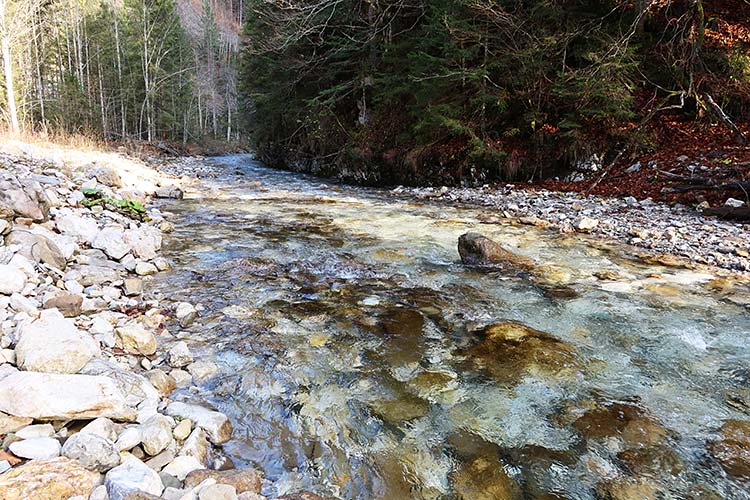
The Savinja river and its tributaries
In its upper course, between Logarska Dolina and Ljubno, the Savinja is protected as a natural monument. Together with its entire course and several of its tributaries, it is also recognised as a natural feature of national importance.
The river's character changes with the seasons and weather conditions, as evidenced by the still-visible traces left by past floods.
Once, the lively Savinja powered numerous mills and sawmills; today, it drives small hydroelectric power plants. With its picturesque course, the river attracts many visitors during the warmer months, while its lower, gentler reaches are popular with anglers and enthusiasts of water sports.
THE SOURCE OF THE ČRNA STREAM
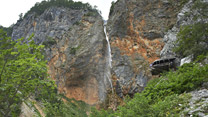
The water soon disappears below the Rinka waterfall before resurfacing in the lower part of the valley. It rises to the surface due to the impermeable Werfen layers and then flows over dark sedimentary clays, which gives it its black colour. From there it flows along a regulated riverbed all the way to the end of the valley, where it merges with the Jezera stream, which flows from the Matkov kot valley and forms the beginning of the Savinja river. The area of the spring of the Črna stream is located in the lower part of the Logar Valley Trail and, with its water reflections and soft-underfoot path, it is one of the most serene and mystical parts of the landscape park. The spring has been declared a natural monument.

SOURCE OF THE SAVINJA RIVER
The Savinja river springs to the surface at the ?gable? of the valley below the Okrešelj cirque at an altitude of 1,280 meters and then makes its way towards the 90-metre Rinka waterfall. The spring is permanent and the water at the spring is clean, of good quality and potable.
JEZERA STREAM
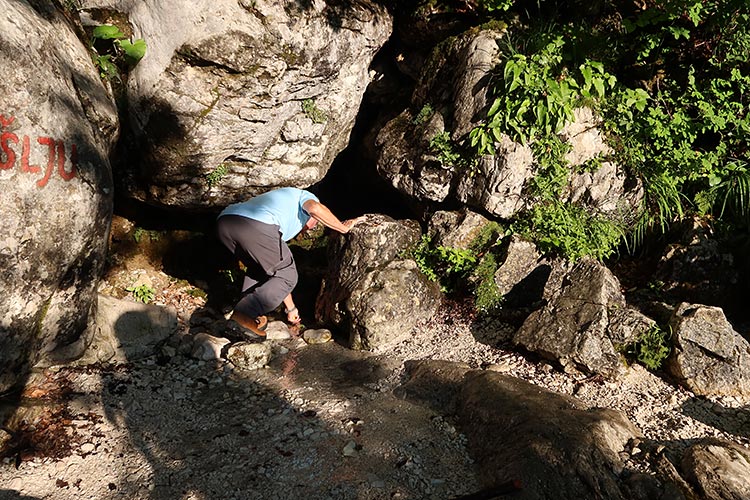
According to legend, a few centuries ago there was a glacial lake in the Matkov kot valley. The water was held back by a natural dam, which allegedly collapsed and the lake drained from the valley. The stream that flows through the valley is still called Jezera (the word ‘jezero’ means ‘lake’ in the Slovenian language), which is a reminder of the valley's ancient past.








TIC Logarska dolina
Visitor Information about the Park
Logarska dolina 9, 3335 Solčava, Slovenia
T: +386 (03) 838 9004
E: logarska-dolina@solcava.si
Zavod Logarska dolina
E: info@logarska-dolina.com
TIC CENTER RINKA, Solčava
Tourist Information and Programs,
Exhibitions, Local Products, Local Guides
Solčava 29, 3335 Solčava, Slovenia
T: +386 (0)3 839 07 10
E: info@solcavsko.info
www.logarska-solcavsko.si


 OBČINA SOLČAVA, 2026, All rights reserved